Women Have Changed. Why Has Society Not?
Yesterday, just when I was trying to muster the strength to get up in the morning, came the news of the death of my former landlady. I was very fond of her and considered her my second mother. There is another reason for that, which I will share with you all some other time. Today, though, let me talk about her husband, whom I call Uncle. He is equally affectionate, kind and helpful. Like Auntie, I considered him my second father. Both were my local guardians, in a way. Away from my home, I found comfort and affection for them. Their home became my second home, a place where I spent a lot of time. Over the years, however, I began noticing things about Uncle that made me uncomfortable. During our interactions, he would sometimes try to get physical, pecking my cheeks with his hand, touching me or hugging me whenever we met. Initially, I dismissed it as affection from a man old enough to be my father. After all, he was a father figure to me. But as I spent more time with them, I realised that he seemed to enjoy touching me. That changed the way I looked at those gestures. There were occasions when I even rebuked him in front of Auntie. But she was so innocent that she simply could not understand what was making me uncomfortable. After Covid, I moved into my own home. Our interactions became less frequent. We would mostly speak on the phone, exchanging greetings and checking on each other. When Auntie’s health began to deteriorate, Uncle started calling almost every day. He would video-call me. But instead of asking how I was doing or talking about Auntie, he seemed more interested in looking at me—commenting on my hair, my face, how I looked, why I hadn’t coloured my hair, what I was doing about my acne and so on. I would get irritated, but I kept quiet, partly out of respect for his age and partly because I didn’t want to create an unpleasant situation. When it continued, I eventually stopped taking his calls. Then he started making videos using photographs of me that he had clicked and sent them to me. Sometimes I wondered: I have given this man the place of a father. I have treated him like my second father. Do I deserve to be treated this way? Could he have behaved like this with his own daughter, a woman my age?
It also reminded me of Mira Nair’s ‘Monsoon Wedding’ that had powerfully weaved the sensibilities and the trauma of a young girl who was molested by her own relative. The movie had left me shocked and disturbed not merely because of the abuse itself, but because of the silence surrounding it, and the uncomfortable reality that such violence can exist within the very spaces and relationships that are supposed to offer safety and protection.
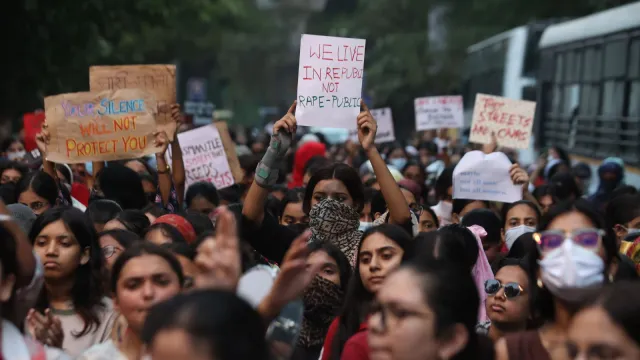
Well, that’s the tragic reality for most girls and women in India. At a time when there’s an outrage on the safety of women at public spaces with three reported cases of sexual assault against teenage girls coming to the forefront, let’s not forget about the predators that women face every day right inside their houses. Mind you, these cases are not confined to India. It’s a global menace.
Figures substantiate it. According to global and national crime reports, most sexual assaults against women are committed by someone known to the victim, including intimate partners and family members.
The World Health Organisation (WHO) estimates that roughly 1 in 3 (30%) women worldwide experience physical or/and sexual violence in their lifetime, with most of the non-partner sexual violence and abuse perpetrated by family members or acquaintances.
According to the National Crime Records Bureau (NCRB) and related institutional data in India, over 95% to 96% of sexual assault and rape cases involve perpetrators known to the victim, with family members, relatives, and close acquaintances accounting for a vast majority of these offenses.
A look at these records makes me wonder whether they offer some explanation for the mores and taboos that Indian society historically imposed on girls and women in their interactions with male members of the family. Sociological accounts indicate that in many traditional communities, the behaviour and conduct expected of women and girls vis-à-vis their fathers and other male relatives were clearly demarcated. After attaining puberty, a daughter was often expected to observe certain forms of physical and social distance from her father, behave with greater restraint, and avoid direct or informal interactions.
Similarly, norms governing relationships between brothers-in-law and sisters-in-law, fathers-in-law and daughters-in-law, and other male-female relationships within the extended family were explicitly defined. Women were often expected to observe forms of modesty and deference such as covering their heads in the presence of senior male members, maintaining physical distance, and speaking to them with a prescribed degree of restraint.
These practices varied considerably across regions, communities and social groups, but their underlying emphasis on regulating proximity and interaction between men and women within the family appears to have been deeply embedded in traditional social structures.
But did these restrictions protect women and girls from sexual assault? The answer is NO. Rather, the social structures that imposed silence, distance and strict codes of conduct often left women and girls more vulnerable to abuse within the family and community. Sexual exploitation remained hidden, while survivors were expected to endure the physical, emotional and psychological trauma in silence. In many cases, they were not even permitted to speak about what had happened to them, let alone seek justice or hold the perpetrator accountable.
The emphasis on protecting women through restrictions on their behaviour and interactions, therefore, did little to address the real source of sexual violence, the actions of those who chose to violate their bodily autonomy.
So, what makes women vulnerable and unsafe even after becoming educated, independent and vocal about their rights?
The answer lies in the inherent contradiction that society has failed to address. Women have become educated, financially independent, make their own choices, question discrimination but the structures and attitudes around them haven’t changed at the same pace.
According to the WHO, nearly one in three women globally has experienced physical and/or sexual violence in her lifetime. In India, NFHS-5 found that nearly 29% of ever-married women aged 18–49 had experienced physical or sexual violence by their husbands.
French sociologist Pierre Bourdieu refers to it as symbolic violence—forms of domination so deeply embedded in society that they begin to appear normal.
A woman is encouraged to study and work yet expected to adjust more at home. She can earn independently yet be questioned about how she spends her money. She can be assertive but be labelled difficult. She can say no but is expected to explain why.
Women have gained a social stature, but social expectations have not always kept pace. And when women challenge those expectations, resistance follow.
The problem becomes particularly visible in public spaces. Women are routinely advised to dress carefully, avoid certain places, return home early, share their location and remain alert, raising a bigger sociological question: Why does society spend so much time teaching women how to avoid violence rather than teaching men not to perpetrate it? Many feel it’s the battle for who has got the POWER.
Sociologist Erving Goffman explained it by showing that gender is not a natural biological trait, but a socially constructed performance maintained through everyday rituals and interactions. The seemingly small things matter who leads, who interrupts, who accommodates, who is allowed to be angry and who is expected to remain pleasant.
Over time, these interactions create a social script. And women who refuse to follow that script face a backlash.
How often do we see this double standard in everyday life? An assertive man is called confident, while an assertive woman is called aggressive. Similarly, a man who refuses to compromise is seen as strong but a woman who does the same is called difficult.
Experts call it the patriarchy mindset, which traces its roots to the earliest division of labour. In ancient times, men, drawing on greater physical strength, were largely engaged in hunting and activities outside the home, while women bore children and took on primary caregiving.
Over time, division of labour gave way to division of power. Roles transformed into social expectations. While men became associated with authority and resources, women were expected to stay at home and do household chores.
What may have begun as a practical arrangement gradually evolved into a patriarchal system embedded in family, property, customs, institutions and social norms, and passed down generations. With time, the real power of patriarchy lay in making inequality appear natural.
But then coming back to my original concern, if patriarchy is often discussed as a system of male dominance, why does that sense of entitlement sometimes extend even to women and children within the family?
Experts are of the view that though kinship creates a sense of trust and protection, in cases of sexual abuse the same trust and proximity gets exploited. The family, instead of becoming a protective shield, becomes a space where power, silence and misplaced notions of family honour allow abuse to remain hidden.
The issue, according to them, is therefore, not sexual desire alone. It is what happens when power, entitlement and impunity override boundaries even within the most intimate relationships.
In 1895, Sociologist Émile Durkheim in his book ‘The Rules of Sociological Method’ addressed it and argued that sociology must look beyond individual behaviour to the social facts and structures that shape individual lives. That is precisely the shift needed in the debate on women’s safety. We tend to ask: Why didn't she leave? Why did she go there? Why did she trust him? Why didn't she report it? It’s time we asked what kind of social environment makes violence possible, normalises control or discourages women from challenging it?
This does not remove individual responsibility. A perpetrator remains responsible for his actions. But it reminds us that individual acts occur within social structures.
And those structures are learned.
Children learn them at home. They encounter them at school. They see them in films, advertisements and on social media. They observe them in workplaces. They absorb them through jokes, casual remarks and everyday interactions.
Which is why changing the conversation about women cannot begin and end with women. If girls are taught self-defence, boys must be taught self-restraint. If girls are taught to identify inappropriate behaviour, boys must be taught boundaries.
If girls are taught to say no, boys must learn to respect that no.
If girls are encouraged to become financially independent, boys must learn that economic independence does not diminish a woman's right to equality at home.
Schools and colleges therefore have a role beyond academic education. Gender equality, consent, respectful masculinity, emotional literacy and healthy relationships should become part of growing up not topics introduced only after a sexual assault makes headlines.
‘Smash the Patriarchy’ will remain just as a campaign by just not dismantling merely by producing educated women; it can be dismantled when the social meaning of masculinity and femininity changes.
The real measure of progress is not whether women have the courage to speak, walk freely or earn independently. It is whether society allows them to do so without fear, punishment or unequal expectations.
Women have changed. Now society must change with them.

Pratigyan Das
Editor
Pratigyan Das is a senior journalist with The Times of India. She has an experience of more than 14 years in journalism. She has a nose for hard news, especially politics, education and issues that concern India and the world. An avid reader and observer, she also looks for the unconventional in the mundane to develop impactful stories.
Latest Posts